
When The Fortune lay anchor off the coast of Cape Cod in 1621, Rachel Haverford believed she, like her fellow passengers, would be starting life anew. But the bleak and desolate landscape bears no resemblance to what they had been promised, and the supposed thriving community at Plimoth turns out to be nothing more than a handful of crooked houses inhabited by people twisted by their own fear.
Marked as a “stranger” by the devout settlers, Rachel struggles under the weight of their suspicious eyes which, follow her every move, especially when her gift for healing comes into question as people around her die and accusations of witchcraft begin to swirl. Finding protection in the arms of a Pokanoket warrior, Rachel soon discovers the line separating friend and enemy is blurred beyond what she had ever imagined.
Featuring the underlying tension between the European colonists and the native tribes of New England, Thorn of Plimouth traces one woman’s fight for survival and her journey to discover the true meaning of home.
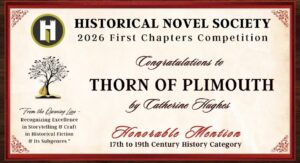
Awards & Nominations


Latest Book Reviews
Thorn of Plimouth traces one woman’s fight for survival and her journey to discover the true meaning of home.
There is something wonderfully satisfying about picking up a historical novel and discovering within the first few chapters that you are in the hands of an author who not only knows the history but also knows how to tell a compelling story. ‘Thorn of Plimouth’ by Catherine Hughes is one such novel.
Set in 1621, the novel takes the reader to the Plimouth Colony, a settlement still struggling to establish itself. Hunger and disease remain very real threats, while relations with the Indigenous peoples whose land the English have settled upon are far more complicated than many of the colonists are willing to acknowledge. Hughes captures this precarious world wonderfully, but the history never feels like a backdrop constructed around the characters. It is woven through their everyday lives, their fears, their beliefs and the decisions they make, giving the novel a tremendous sense of authenticity.
Rachel Haverford is travelling aboard the Fortune with her father when the novel begins. Their destination is Plimouth, where they hope to begin a new life amongst the settlers who had established the colony the previous year. Rachel is Welsh and deeply proud of her heritage, and she has inherited from her mother an extensive knowledge of herbs and healing. With her striking red hair, she is perhaps more noticeable than she would like to be, but Hughes refreshingly avoids using her appearance as shorthand for a fiery personality. Rachel is compassionate, thoughtful, and gentle by nature, and it is her very ordinariness that makes her so easy to care about. She is not rebellious or confrontational; she is simply a young woman hoping to find her place in an unfamiliar community. To read the entire review, visit:
https://maryanneyarde.blogspot.com/search?q=thorn+of+plimouth
In Thorn of Plimouth, Catherine Hughes transports readers to 1621, when the promise of a new beginning in America came wrapped in hardship, uncertainty, and deeply rooted prejudice. Aboard the Fortune, young Rachel Haverford journeys toward the fledgling English settlement of Plimouth, carrying the grief of losing her mother and the healing knowledge that mother passed down to her. Rachel’s skill with herbs and traditional remedies should be a blessing in a community struggling with sickness and death. Instead, it draws suspicion from those who see the Devil’s influence in anything they don’t understand. As whispers of witchcraft begin to follow her, Rachel discovers that surviving the wilderness may be easier than surviving the judgments of her fellow settlers. Hughes builds a compelling story around a young woman whose greatest strength, her determination to care for others, threatens to make her an outcast.
Thorn of Plimouth