
Normandy, 1064
Celia Campion, a girl of humble background, finds herself caught in a web of intrigue when Duke William commands her to work as his spy, holding her younger sister hostage. Her mission: to sail across the sea to Wilton Abbey and convince Margaret, daughter of Edward the Exile, to take final vows rather than form a marriage alliance with the newly crowned king to the North, Malcolm III of Scotland. Preventing a union between the Saxons and Scots is critical to the success of the Duke’s plan to take England, and more importantly for Celia, it is the only way to keep her sister alive.
In this sweeping epic that spans the years before and after the Conquest, two women from opposite sides of the English Channel whisper across the chasm of time to tell their story of the tumultuous days that eventually changed the course of history. As they struggle to survive in a world marked by danger, loss, and betrayal, their lives intersect, and they soon come to realize they are both searching for the same thing–someone they can trust amidst the treachery that surrounds them.
Together, their voices form a narrative never before told.

Amazon


Purchase a Copy

Barnes & Noble

Author Interview
Author Interview
Author Interview

History Bards Down Under Interview
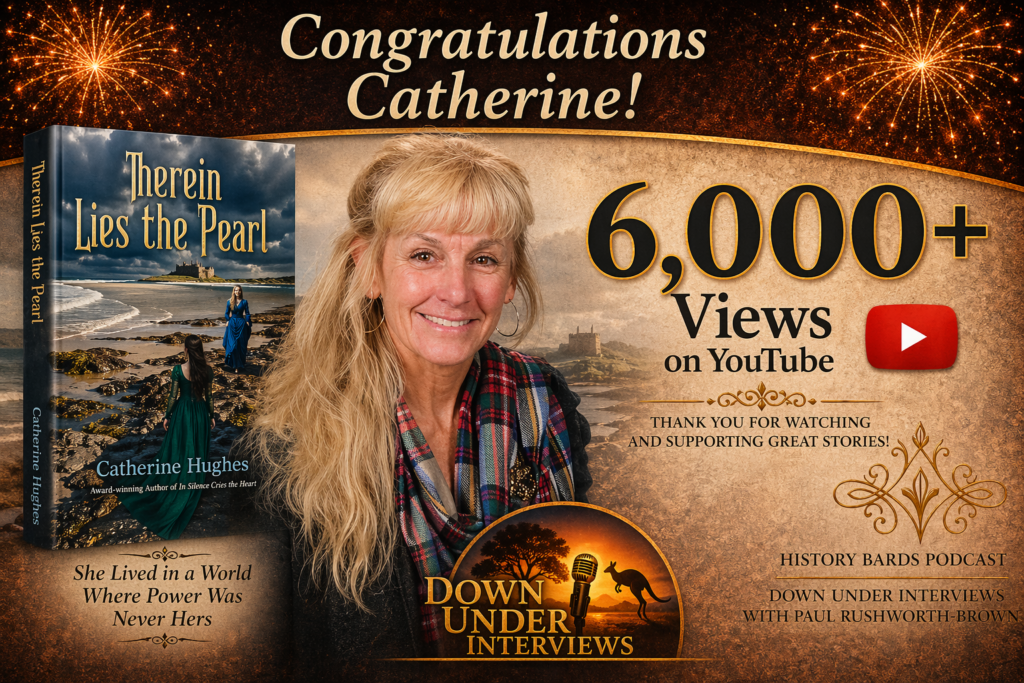
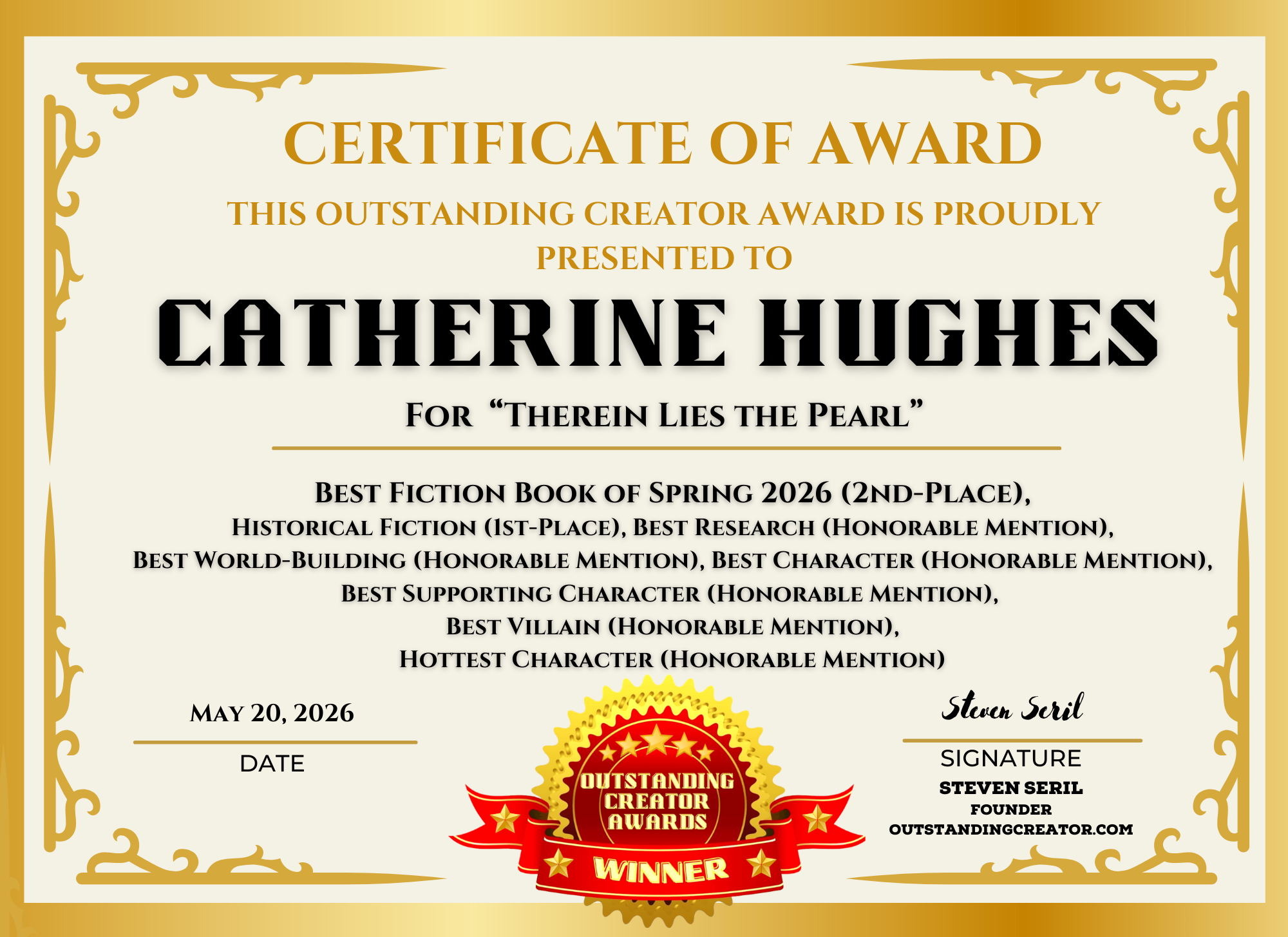
Awards & Nominations






Latest Book Reviews
Catherine Hughes has created something rare: a narrative that not only recreates a pivotal moment in time but also explores how ambition, devotion, and circumstance combine to shape individual destinies.
To read more, visit Mary Anne Yarde’s full review on her website: https://maryanneyarde.blogspot.com/2026/01/editorial-book-review-therein-lies.html

“Catherine Hughes has, perhaps, surpassed herself with her latest offering, ‘Therein lies the Pearl’ . . . the writer invites the reader into the truly murky world of Europe [principally England and Normandy] of the mid eleventh century and, in particular, the events leading up to the Norman Conquest of England in 1066 and the results thereafter. . . . [The novel] remains a fine and impressive book to grace the bookshelf of any historian or aficionado of fine historical fiction and to be treasured as such, for … its moments of deep lyricism. . . . this is a fine and beautifully crafted tale of a distant period of time and the emotions described very much resound in our own century. We are also left with two exceptionally fine woven portraits of the two central characters. This is a fine work of which the writer can be justifiably proud.”
In Therein Lies the Pearl by Catherine Hughes, set in the 11th century, Celia Campion comes of age near Caen
as Norman power tightens around the Channel. Violence strips away all semblance of family security and places
her inside the household of Duchess Matilda. Celia is sent to England under a false religious identity to remain
close to Margaret of Wessex, whose bloodline has consequences during King Edward’s decline. Despite court
life being full of threats and coercion, Celia reports back to Normandy—a duty demanded of her in return for her
sister's safety. While Harold Godwinson advances his position and William waits across the water, every day
places Celia beside the decisions that influence public rule, as England moves toward invasion.
Therein Lies the Pearl by Catherine Hughes is a brilliant historical novel, written primarily from the unique
perspective of an outsider on the inside. Hughes breathes pure life into eleventh-century England and
Normandy, and we see both domestic labor and court ritual, from laundering linen beside cold rivers to oaths
taken before relics. Even the ducal stables at Caen ooze with heat, straw, and rank. Celia is the standout
character, whose brutal series of losses, which nearly broke me as each happened, only strengthened her self-
command and a genuine care for others, even when her agency is removed. Margaret of Wessex is also a fully
formed character, defined by moral steadiness and a mind that guides others during danger. The writing is crisp
and elegant, and this is an excellent novel for lovers of medieval history, court intrigue, and women shaped by
power, faith, and duty. Very highly recommended.
There are novels that announce themselves with noise and colour, and there are others—rarer, more
enduring—that arrive quietly, like a tide felt first at the ankles. Therein Lies the Pearl belongs to this
latter company. With a calm authority and a grave, attentive sympathy, Catherine Hughes draws us into
a world shaped by power and prayer, by hunger and devotion, where women move through danger as
through air—necessary, invisible, and life-altering. What emerges is not merely a recreation of history,
but a meditation upon how lives are fashioned at the intersection of will, faith, and circumstance.
The novel opens not so much at a beginning as at a moment of culmination. Upon the North Sea, amid
wind and water and the indifference of nature, Celia clings to the mast—her body strained, her fate
suspended. It is a scene held taut with meaning, for this storm is not simply weather but reckoning: the
visible sign of a life converging upon a single instant. From this frame the narrative turns inward and
backward, unspooling the long sequence of choices, losses, allegiances, and quiet betrayals that have
carried her here. What matters is not the question of survival, but the deeper inquiry into how such a
moment comes to exist at all.
Hughes’s great achievement lies in her rendering of women navigating worlds designed for their peril.
Celia’s life is governed by flight and hunger, by violence and the constant nearness of male authority.
Her fierce devotion to her sister Vivienne both steadies and imperils her, binding love to vulnerability.
When she enters the orbit of Matilda’s court, it becomes clear that favour is never benign. Protection is
a kind of possession; generosity carries its own demands. Power here is not shouted but murmured,
enacted through gifts, smiles, and the precise deployment of words. The court scenes vibrate with an
almost imperceptible tension, as though every courtesy conceals a blade.
Set against Celia’s outward dangers is the inward trial of Margaret, whose life unfolds under the weight
of expectation, sanctity, and watchful eyes. Her faith is neither decorative nor naïve; it is lived, wrestled
with, endured. Hughes writes with particular delicacy of Margaret’s longing for contemplation, and of
the visions that interrupt her prayers—visions rendered with such restraint that they feel less like
spectacle than intrusion. When prophecy inscribes itself upon Margaret’s own body, the boundary
between the spiritual and the physical dissolves, leaving the reader unsettled and moved in equal
measure.
The historical world itself is drawn with an almost tactile precision. Birth and illness, prayer and travel,
cold, hunger, and exhaustion are woven seamlessly into the larger movements of dynastic ambition and
political unrest. Normandy and England emerge as places of splendour edged with threat, where loyalty
is provisional and alliances shift like light upon water. Historical figures step forward not as
monuments but as men and women thinking, calculating, erring—human in their frailties and
formidable in their reach.
Matilda, in particular, is rendered with striking subtlety: intelligent, observant, measuring constantly
the worth of those around her. Her patronage is both invitation and warning, and Hughes captures the
ambiguity of her power with exquisite control. Duke William looms with a quiet, ominous steadiness,
but it is Harold Godwinson who unsettles most deeply. His presence darkens the page; entitlement and
appetite travel with him like a shadow. The novel never overstates his menace, trusting instead in the
reader’s instinctive unease.
Love, too, is treated without illusion. Celia’s bond with Simon unfolds gently, hesitantly, shaped as
much by fear as by desire. What they offer one another—companionship, safety, the promise of a
shared life—can never be separated from risk. Affection is costly here; commitment always exacts its
toll. Often it is in the smallest moments—a glance held, a task shared, a question left unanswered—that
the novel’s emotional force gathers and breaks.
What distinguishes Therein Lies the Pearl above all is its moral seriousness. Hughes resists the comfort
of clear heroes and villains. Instead, she presents lives constrained by forces beyond their choosing,
where power operates as much through silence and ownership as through conquest. Faith is shown not
as refuge alone, but as struggle and endurance; ambition burns brightly, yet threatens to consume those
who shelter it.
As the narrative draws toward its close, the pressure of approaching history is keenly felt—the crown
unstable, the realm poised, the future narrowing. Yet Hughes refuses the grandeur of hindsight. She
remains with her characters in the fragile present, where every choice matters, where delay may prove
fatal, and where knowledge of what will come offers no comfort at all.
Therein Lies the Pearl is a novel of rare intelligence and depth—absorbing without excess, scholarly
without rigidity, romantic without deception. Above all, it is profoundly compassionate: toward its
women and its exiles, its believers and its doubters, its survivors. For readers who seek historical
fiction rich in atmosphere, emotional subtlety, and moral insight, this is a book to be read slowly,
attentively, and remembered long after the final page.

Two young women, kindred spirits, Celia from Normandy and Margaret, the daughter of Edward the Exile, come
together in a thrilling adventure set in the eleventh century, during the days leading up to the Norman Conquest.
Catherine Hughes’ Therein Lies the Pearl takes history as we often read it and presents it from the perspectives
of the women who struggled to survive in a world that didn’t accept them for their worth. Her story is based on
the turbulent royal history of the era, the childless King Edward, his nephew Edward the Exile, Harold the Earl of
Wessex and East Anglia, William the Duke of Normandy, and when all these royals and would-be leaders of their
time plotted to gain power. It’s always about power and the greed of men. But what about the women? How did
they survive the adversity of men vying for their sexual favors, those they don’t care to share, along with the
loss of loved ones and death all around them?
Catherine Hughes’ Therein Lies the Pearl is a fascinating historical novel that follows two women instead of the
men who controlled their lives. This intense story unfolds with a shipwreck scene that introduces Celia.
Backtracking in time, we learn a little about Celia’s upbringing. The story then switches to introduce Margaret,
the royal who really wants to follow her faith, a path often chosen by noble women. The author presents
historical facts with precision and develops the characters with believable qualities for this era. Descriptive
narrative is effectively employed to set the stage and move the drama forward. The book comes to a full circle at
the end, and then the author lays out the key points of each section of the book, presumably to assist those
wanting to share the story and study it further. This is a fascinating and educational read.
Therein Lies the Pearl by Catherine Hughes is one of those historical novels that I devour with great
pleasure. Set in Normandy and England in the eleventh century, in the years leading up to the Norman
Conquest in 1066, it focuses not so much on the kings and the pretenders to the throne but on two women
who play an integral part in history. Celia is a young peasant whose family was destroyed, and her village
wiped out by marauding soldiers. She seeks sanctuary from the local Duke William, who has his eyes on
the English crown, where she becomes a confidante and spy for the Duchess. Margaret is the daughter of
the English King’s nephew, Edward, who has been living in exile in Hungary. When Edward is called back to
England as a possible successor to the childless King Edward the Confessor, Margaret and her siblings
immediately become prime targets of anyone seeking to usurp the crown. The lives of these two very
different women will soon collide as the intrigue and treachery of the English court envelop their lives.
What I absolutely loved about Therein Lies the Pearl is that although the story is centered around well-
known historical figures and happenings, it is the individual lives, dreams, and loves of Celia and Margaret
that dominate the narrative. Catherine Hughes has woven a marvelous story of love, loss, tragedy,
treachery, and fortitude against the background of men’s continual battles for power, position, and land.
This is an epic tale. While it narrates the events leading up to the Norman invasion, it also concentrates on
the backstabbing and betrayal in the corridors of power, whilst still enabling readers to fully understand
and empathize with the innermost thoughts of these two exceptional young women. I truly appreciated the
gentler, romantic, and thoughtful passages that delved into Celia's and Margaret's familial lives as well as
romances. History is best understood when readers view events from both sides of the battle for power.
This story is essentially about two young women rising above their supposed stations in life to chart their
own destinies and follow their own hearts. This is what makes it such a powerful novel. I highly recommend
it.
Riveting storytelling about love and heartbreak in the 11th century
Reviewed in the United States on February 4, 2026
Format: PaperbackVerified Purchase
Having read another book by the same author, I was curious about this one, and oh boy, it did not
disappoint. In fact, I had a hard time putting it down, so wrapped up in the stories of Celia and the historical
figure of Margaret. The 11th century was not a gentle time; violence and death were always within arms
length. But the author made me care about the fictional characters as much as about Margaret, and there
are plenty of heartbreaking moments as their intertwined stories unfold. I was not familiar with Margaret and
her important role as the wife of King Malcolm III of Scotland. The author managed to weave the historical
facts into a compelling story, even while helping me to understand more of that complicated history of the
descendants of King Edward the Confessor, the last reigning monarch of the House of Wessex, and their
role in the battle for control of the kingdom by William the Conqueror. The book is literally awash with
appealing details that give the story a wonderful texture and vividness. The work of digging a grave was a
novel experience for me, and yet, the author managed to make it so very real that I nearly broke out in a
sweat, and along with the young woman engaged in the digging, I breathed a sigh of relief when the soil
started to soften a little. The story is an amazing and skillfully handled blend of history and imaginative
storytelling. The extent to which the author stayed faithful to the historical record is evidenced by the
carefully prepared series of notes at the end.
Highly recommended.
At the heart of the novel are Celia and Margaret, two compelling women whose lives intersect amid political unrest, personal trials, and mounting suspense. Hughes crafts their journeys with emotional depth and nuance, allowing readers to feel their fears, hopes, loyalties, and resilience. The drama that unfolds around them is both intimate and sweeping, blending personal stakes with the larger uncertainties of a nation on the brink of transformation.What makes this novel truly stand out is its pacing. It is a genuine page-turner—filled with anticipation, tension, and moments of unexpected revelation. Just when you think you understand the direction of events, Hughes introduces new layers that keep the excitement building. The balance between historical detail and narrative drive is masterfully handled.
I highly recommend this author and her two award-winning novels. With storytelling this powerful and immersive, I am genuinely excited to see what she writes next.
Interview: https://featheredquill.com/author-interview-catherine-hughes/
The course of English history took a sudden, bitter and permanent turn in the fall of 1066 when Duke William of Normandy, the Conqueror, defeated the Saxon army of King Harold at Hastings. England became Norman. But the ancient Saxon bloodline did not die at Hastings. It was carried on by Edgar, the grandson of Saxon kings, and by his sister, Margaret, known as the Pearl of Scotland. History has a way of overlooking, even denigrating, the women who helped make it. Royal Margaret is a pawn for would be kings. Celia Campion is Norman. But she isn’t royalty. She is an orphan charged with protecting her baby sister. Like the biblical Job, both women are battered by fate but, strong, independent and courageous, they refuse to cower. Celia is in love with Simon, a brawny soldier who goes to fight for William while she is cast as a spy for the Norman duke, placing her at odds with the Saxon princess Margaret.
Like any good historical fiction, Therein Lies the Pearl teaches effortlessly as it pulls you into its tale of love, intrigue, danger and survival. It satisfies the lover of historical fiction and the fan of romances fraught with uncertainty. Can happiness be found in a world of ceaseless violence? Can friendships be forged despite historic animosities and class differences? Sometimes the dialogue seems a bit spot on, in moments of passion, theatric, not crispy enough. A burst of emotion sizzles, while too much inner thought can be repetitive and unnecessary. Even so, the novel never slows down, though the end may startle readers with an unforeseen twist. Therein Lies the Pearl checks off all the boxes for readers wanting to explore a place and time they’ve never been.
Therein Lies the Pearl